 Introducing a new publication for those interested in historical railway tickets Introducing a new publication for those interested in historical railway tickets |
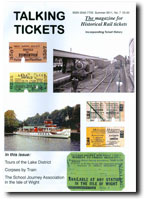 - Full colour - 24 pages
- Published by Bestchart Ltd. (TTM), 6A Mays Yard, Down Road, Waterlooville, Hants. PO8 OYP
- Edited by Brian Pask
- The subscription rate from Autumn 2011/12, for UK addresses, is £21.50
|
 |
| Ordinary Single & Return Tickets of the Midland Railway (new from Solo Publication) |
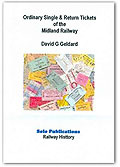 An advertisement for a new book about railway tickets: An advertisement for a new book about railway tickets:
This is the fourth of the studies by David Geldard, identifying the different ticket types utilised by the Midland Railway and covers tickets for all journeys, including travel over other railways and those on lines jointly owned.
The book is the latest in a series intended to cover the tickets of all pre-Grouping railways in Britain. Those of the Great Western Railway and the SER, LCDR & SECR have already been published
Special Offer
This book is available until 30th Noveber 2008 at an introductory price of £16 (including postage and packing). Please note that the special discount allowed to members or the Transport Ticket Society and similar organizations does not apply to this offer.
After 30th November the price will be £20 (including P&P) and discounts will apply as normal for TTS members etc.
Order to: Solo Publications, 80 The Street, Kingston, Canterbury, Kent CT4 6JQ. Please make your cheques payable to "SP Elks"
ADVANCED NOTICE: "Tickets of the Great Western and Great Central Joint Line" by Brian Pask will de available in late October. An introductory offer price similar to the above will be available until 31st December. If you are interested in obtaining this book, please contact us.
|
|
| Some Early Scottish Station Name Changes |
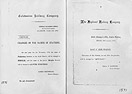 Courtesy of Mr. Victor Williams Goudie of the Shetland Islands... Courtesy of Mr. Victor Williams Goudie of the Shetland Islands...
|
| A solution in Scotland |
Reader Mr. John Roake has sent in the following information – “I have in front of me LMS Northern Division Circular No.62 dated 27th April 1923 stating: “A good deal of trouble has been experienced by the similarity of the place-names Dornoch, Sutherlandshire, and Dornock, Dumfriesshire, and to avoid this it has been decided to alter the name of Dornock Station (G. & S.W. Section) to Eastriggs. The change in name will take place as from 1st May next.”
John comments that in view of the date, is this one of the earliest name changes imposed by the new regime?
|
|
| Pulling the wool over their eyes |
Reader Mr. C. Haydon has supplied us with information regarding Midgham station between Reading and Newbury.
This station is actually located at Woolhampton and was opened as such in 1847. He understands that so many passengers had cheap trips to Wolverhampton and expensive trips to Woolhampton from Paddington, Reading etc. that it was renamed Midgham in 1873 to reduce confusion.
We thank Mr. Haydon and positively encourage further information regarding station naming.
|
|
| A day out with the Institute of Electrical Engineers |
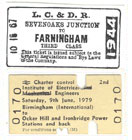
Ticket not for sale |
Ticket 0170 represents an interesting privately organised rail tour which was not advertised to the “gricing” fraternity.
It visited Ocker Hill power station in the Black Country and as far as the compiler knows it was the only rail tour to visit here. This tour also reached the actual Ironbridge power station complex, way beyond where rail tours normally reach. Wooden steps were provided for the patrons to detrain.
The ticket is also clipped three times which is somewhat unusual. Our thanks to reader Mr. Brian Ratheram for information about this trip. |
|
| “Inset Advertisements” - More information |
A firm named “Mones-Cross” entered into a contract with the London Midland & Scottish.Railway (L.M. & S.R.) to supply 250 million “insets”, which the L.M. & S.R. printers then inserted into certain ticket printing runs, e.g. tickets for dogs often contained a “Spratt’s Oval” advertisement. This contract occurred in 1931. Therefore, we now know that the advertisements were called “insets” and not “inserts” and these “insets” were entirely separate from the main body of the ticket, being supplied by a printing firm.
Reader Mr. M. Shelmerdine now supplies us with extra information obtained from the book “Passenger Tickets” by Wiener, which was published in the 1930’s. The “Alta Indian Railway” in 1885 had tickets with a pocket on the back containing a thin sheet of adverts. 10,000 were printed. The pocket being expensive to manufacture, caused the alternative of slipping the sheet inside the ticket to be adopted, it being “hollowed out for the purpose”.
Initial users were stated to be the Italian Mediterranean Railway in 1899, Paris Exhibition in 1900 and Hungarian State Railways in 1908. An alternative form using a thin card insert was patented later in London (no date quoted) as follows. The Insets Development Co. Ltd. had patents covering both the ticket machines (patent 262,522) and “the special Mones-Cross tickets” (patent 310798). The company’s prospectus quoted contracts with the Great India Peninsular Railway (G.I.P.R.) (68 million insets annually), L.M. & S.R. (250 million) and Belfast & County Down Railway (B.C.D.R.) (a mere 1.5 million). “The scheme was given up after a short while”, quotes Wiener.
Mr. Shelmerdine gives an example of a L.M. & S.R. lilac coloured pram ticket from London Kew Gardens, which is a return within a 15 mile zone. The inset is for Curson Bros of 36 Bridge St, London, EC4 “Tailors and Outfitters”, which also proclaims that the inset is exchangeable as follows “at the rate of 2/- in the £ against any garment purchased”. He comments that since the tickets serial number is 029 it is doubted that many were ever issued let alone used in the payment scheme. Finally he has never seen a B.C.D.R. or G.I.P.R. example.
It is recalled by the compiler that examples from the B.C.D.R. are around as the L.M. & S.R. printed their tickets. Has any reader an example of an inset from the G.I.P.R.? It would be very desirable to illustrate one.
Obviously any further comments and development of this subject would be welcome.
|
|
| A Collection of Railway Tickets (Part I) by the late Charles Gordon Stuart |
‘When the first issue of ‘The Railway Magazine’ appeared in July 1897, there were more than 300 different railways, including joint lines, in Great Britain, which issued tickets. By that date, the development of the ticket had fully reached the form that is in use today, namely the Edmondson card pattern. There also were larger paper tickets for through journeys to the lines of other companies, and elaborate folding season tickets, often adorned with the crest of the issuing company. There can be little doubt that, since 1897, the appearance and production of tickets have undergone a vast change, having reached a pinnacle of excellence around 1914, and thereafter slowly but steadily declined with the changes of ownership of the railways.
Inasmuch as every railway company had an individuality of its own, which to many was reflected in its locomotive and rolling stock, or in its stations and signals, so also is it true that a company’s tickets also reflected its individuality, or perhaps I might even say, personality. The tickets of the Great Western Railway, throughout its long separate existence, always maintained an air of quiet prosperity, for they were beautifully printed and designed to the last. The basic colours of white for first class, blue for second, until it was abolished in 1910, and straw for third (changed to green about 1935) were delightful, and set off a ticket at its best.
The Midland Railway’s tickets, especially towards the latter period of its existence, seemed to reflect the aggressive and highly competitive character of this company. During the twentieth century, the Midland used a bright yellow for its first class and a colour best termed drab for its thirds. Second class was abolished in 1875, and a Midland second is a very rare ticket. Others of the pre-amalgamation companies which had tickets that have always specially impressed me were the London & South Western, with its attractive pink thirds, the L.N.W.R., with its title printed out in full in bold type along the head of the ticket, and the Great Northern which used blue for third class, and overprinted its tickets with various stripes and diamonds to indicate through bookings to the Metropolitan and the tube railways.
As a general rule before the grouping of 1923, most railways used white for first class, though in cases where differentiation between up and down bookings were in force, yellow was usually the alternative for white. Second class, which by 1919 had disappeared on all lines excepting the G.N.R., G.E.R., Manchester South Junction & Altrincham, North London, and South Eastern & Chatham, were either pink or blue, and the usual colours for third class were various shades of green, ranging from the darkest to the palest, buff, straw, and drab, with blue on the G.N.R. and pink on the L.S.W.R. and the District. Irish tickets during this period still included second class on several lines, but any attempt to describe them in the compass of a short article is impossible.
It was at the close of the pre-grouping period that I started to collect tickets and persuaded my friends to try and save their tickets for me. It was not very long then before I met other collectors of tickets, and from that time I was able to acquire by exchange, and other means, really old tickets issued as far back as the 1830’s, and to study the development of every company’s tickets from very early days.’
To be continued.
Reference: The Railway Magazine, December 1954.
Acknowledgement: This article was supplied by Mr. Rhys Ab Elis.
|
|
| KEITH & DUFFTOWN RAILWAY |
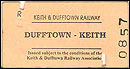
Ticket not for sale |
I was pleased to “rescue” the illustrated Edmondson at Sheffield Railway station supertram stop.
We do not know much about this railway several miles long, apart from the occasional snippet to be found in railway periodicals. Anyway, good to see an Edmondson being issued and perhaps it may encourage some of us to visit the railway; after all it is a scenic line and part of the former Great North of Scotland Railway system.
|
|
| Kent Trams No.1: Tickets, Fares & Passengers of the Dover Corporation Tramways by Ken Elks |
This is the first of a planned series of studies of the tickets and fares from the various tramways in Kent. It identifies the tickets which are known or thought to have been issued by the Dover Corporation Tramway between 1897 and 1935 and sets them in context.
The electric-powered Dover Tramway was the second of its type ever built in Britain and so occupies a position of importance in transport history, as it led the way for the introduction of tramways by other small municipalities throughout Britain.
This book draws upon the official minutes, local newspapers and the surviving tickets from a number of important collections to provide an unrivalled record of the changes in the system of tickets and fares during its years of operation.
If you would like to order this book, it is available at an introductory price of £16.00 (including postage and packing) until the 29 February 2008. After this date the price will be £20.00 (including postage and packing).
Send your order to: Solo Publications, 80 The Street, Kingston, Canterbury, Kent, CT4 6JQ, UK. Please make cheques payable to ‘SP Elks’.
|
|
| CONFUSION OF STATION NAMES - a tale from Mr. Ernest Yeskins |
Several years ago I was visiting the “Watercress” line i.e. the Mid Hants. I booked my ticket at Waterloo asking for a “Day Return to Alton” and showing my network card. As I only had a few minutes until the train left I hurried to the platform.
I then discovered that I had been issued with a day return to Walton on Thames! However, it was too late to return to the booking office so I made the journey. Fortunately, I did not have my ticket checked on the outward journey. On the return journey the booking office at Alton was closed so I had to travel back with the erroneous ticket. The return journey was also completed without any checks being made.
|
|
| Insert Advertisements and the London Midland & Scottish Railway |
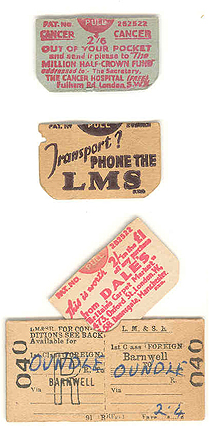 Recently a casual chat with reader Mr. Brian Matthews has inspired a brief look at this interesting subject. In the 1930’s presumably the marketing department of the London Midland & Scottish Railway (L.M. & S.R.) invited private firms to promote their wares and facilities in the form of “insert” advertisements which would be located within Edmondsons printed by the L.M. & S.R. This certainly involved a separate procedure by the printers as the “insert” had to be inserted during the production process between the front and back portions of a ticket.
It is not known how much was charged by the railway, however, if it was a modest amount a break-even situation would have been quite challenging. How many different advertisements are there? In the best part of 20 years trading, only around 30 different advertisements have been seen by us. These have been found in tickets issued during the 1930’s through to the 1960’s, plus audit tickets. They have been seen in various ticket types ranging from the normal single through to dog tickets and platform tickets. The only logical advert has been “Spratt’s” dog food which can be found in dog tickets. Apart from that the advertisements could appear covering any journey on the system, with some of the journeys not being very popular, hence the number of tickets still on issue in the 1950’s and 1960’s. This suggests that the advertisers faced mixed fortunes of failure and success regarding user response. In theory the user was to remove the “insert” and retain it. There could have been “inserts” on certain local tickets, e.g. within the Glasgow area promoting a certain brand of whisky and just related to one print run over a short time period. Therefore, the probability of seeing one of these tickets nowadays is very low and as a result much speculation is involved as to how widespread the use of this marketing tool was.
There was an insert self advertisement for the L.M.& S.R. offering its transport services, as illustrated, both sides of course with its different texts. Two other illustrations are offered with the aim that readers can come forward with more information regarding this hitherto largely unreported subject, which we are sure will be of interest to most of you.
|
|
| Station Names |
The names of stations are an obviously fascinating subject with no end of curiosities. Did you know, for example, that there are at least fifteen “Suttons”, ten “Newports” and nine “Waltons”?
These include variations in the titles, e.g. Sutton and Sutton Coldfield, Newport (South Wales) and Newport Pagnell. More unusual names occurring three times each include Bramley, Overton and Waterfall, whilst there are at least twenty three names occurring twice, e.g. Moira and Kimberley, which incidentally are female first names. It is interesting to note that these names do not occur in the same town but in different towns, often far apart, e.g. Barry in South Wales and Barry in Tayside. Some names are frankly odd. The North of England boasts Swine, Low Row, Mumps, Triangle, Crank, Rookery, Idle, Mow Cop and even Talk o’ th’ Hill! The Great Western boasted examples such as Bugle, Blue Anchor and Shepherds. Scottish examples include Highlandman, Crook of Devon King Edward and Gatehouse of Fleet. Nigg and Rigg could be potentially confusing; perhaps it is just as well that they are both long closed. Ireland has examples such as Oola, Nobber, Pluck and Horse and Jockey. How about the two occurrences of Pant in rural Shropshire and the other example not too far away in South Wales, which has reopened as part of the Brecon Mountain Railway?
The speciality of numerically named stations provide even more thought on this subject, e.g. Three Counties, Five Mile House or the straight forward Twenty which was located on the Midland & Great Northern railway system.
The railway companies did not engage in flippant naming of stations, after all it was a serious business opening new stations with the aim of attracting as many passengers as possible to begin to recoup some of the expenditure of construction. Therefore, the station names reflected the name of the local environs which in many cases can easily be detected on Ordnance Survey maps. However, some names were a trifle inaccurate in the sense that the actual towns which some stations purported to serve were in fact some distance away from the station, in many cases miles were involved.
This information was gleaned from an article by H.L. Hopwood in the December 1917 edition of the Railway Magazine, pages 391-394. Hopefully Mr. Hopwood has stimulated us.
If any reader has some anecdotes they would like to share with us all regarding this subject, then we look forward to hearing from you.
|
|
| Ticket printing economies in "The Great War" |
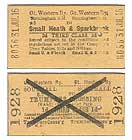
Ticket not for sale |
The ticket illustrated may just appear as an ordinary single from Birmingham Snow Hill issued from the German "Regina" machine during 1916; itself rather an irony! However, the other side of this ticket shows a very interesting situation. The ticket was originally printed as a single from Southall to the elusive TRUMPERS CROSSING HALT for OSTERLEY PARK, located on the Brentford branch. This halt was opened in 1904, closed as an economy measure in 1915, re-opened in 1920 only to close again this time on a permanent basis in 1926. Therefore, what must have happened is that the stock was withdrawn from Southall in 1915, the original journey details printed over with a black cross as shown and then sent to Snow Hill to be issued from the "Regina". As the back was blank, this stock of tickets was ideal for the purpose. It is also interesting to note the quite high series number of 7. This indicates that Southall had perhaps over-estimated the demand for this journey, or that there were large numbers of tickets issued. It is suspected that the first scenario existed; as if many tickets were issued then surely tickets would not be so scarce from this halt. This is the first time that the compiler has seen a ticket featuring the halt. Our thanks to Mr. Ernest Yeskins who was instantly able to deduce the "for Osterley Park" affix. |
|
| Roy Hamilton MBE - Collector of Railway & Water Tickets |
| As many readers will now be aware, Roy Hamilton passed away in early November 2003 at his Rutherglen home. Obituaries and appreciations have already appeared in certain publications including "The Times" newspaper. Therefore, it suffices to say that in spite of a most unfortunate accident in 1961, at the now closed Cleghorn station, which resulted in the loss of both legs, Roy almost carried on regardless. This says a great deal about the man. I was "graced" to spend well over an hour with Roy at his other "home" the ticket office cum-shop at "Boat" station on the Strathspey railway, in mid September. He was clearly happy to savour the fact that "Boat" was once again no longer a terminus due to the recent re-opening of the Broomhill extension and indeed the eventual extension to Grantown-on-Spey. However, the opening of the extension had bought with it many enquiries to him from the general public, who assumed that "Boat" was now the main station on the railway and wanted to know where to park their cars! We chatted in general and Roy appeared to be reasonably satisfied regarding the stabilising and future of Scotrail. An anecdote emerged regarding the splendid "griddle cars", which were in use on the Highland line until the early 1980's.and featured separate dining and bar areas. Roy used to dine and enjoy a beer or two, until eventually moving to his carriage at Pitlochry. A far cry from the trolley refreshment service provided now. Ticket wise, Roy told me of the difficulty he had in obtaining the Edmondson tickets which were provided in the summer of 1986 regarding the new stations of Bathgate, Livingston North and Uphall. They were supposed to be issued by the guards in the evenings. As this meant extra work for the guards, they much preferred to use the normal omniprinter machines. Roy eventually succeeded, even though today these tickets are scarce. It is to be regarded as a great privilege that time was able to be spent with this highly regarded and esteemed gentleman before his sudden and unexpected demise, just six weeks later. |
|
| More on Laira Halt |
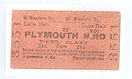
Ticket not for sale |
We were very pleased to receive from reader Mr. S. Mcmullin, an image of a ticket issued from the halt, dated 7th August 1926. Mr. Mcmullin comments that the halt was only open for 26 years, which is also the year of issue! By this time the "e" had been dropped from the end of Halt. Nowadays it is quite challenging to identify the exact location of the Halt from a train, there is certainly station style metal fencing in the area on the "up" side, but as trains are travelling quite quickly little else can be detected. |
|
| The last day of passenger service |
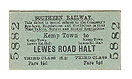
Ticket not for sale |
This ticket is dated 31 December 1932, the last day of passenger service on the KempTown branch, located in the east of Brighton. Lewes Road Halt was an intermediate station and the compiler has yet to see a ticket from Lewes Road Halt. This ticket would have been purchased as a farewell souvenir. The branch continued in use to serve a coal depot at Kemp Town until final closure in 1971. The closure was marked by some special trains operating from Brighton to Kemp Town. |
|
| A scarce platform ticket |
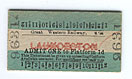
Ticket not for sale |
This example (click on ticket to see enlarged version) is from the Great Western station at Launceston, Cornwall, which closed in 1952, when passenger trains were diverted to the adjacent "Southern" station (closed in 1966). However, the Southern site is back in railway use serving as access to the narrow guage Launceston steam railway. The ticket is dated 27/10/1950 and is of pre-grouping origin. Platform tickets issued at the Southern station can be quite easily obtained, however, our G.W.R. example is scarce. A defect in the printing process has rendered the name Launceston a little blurred. |
|
 Historical Corner